Friday, November 12, 2010

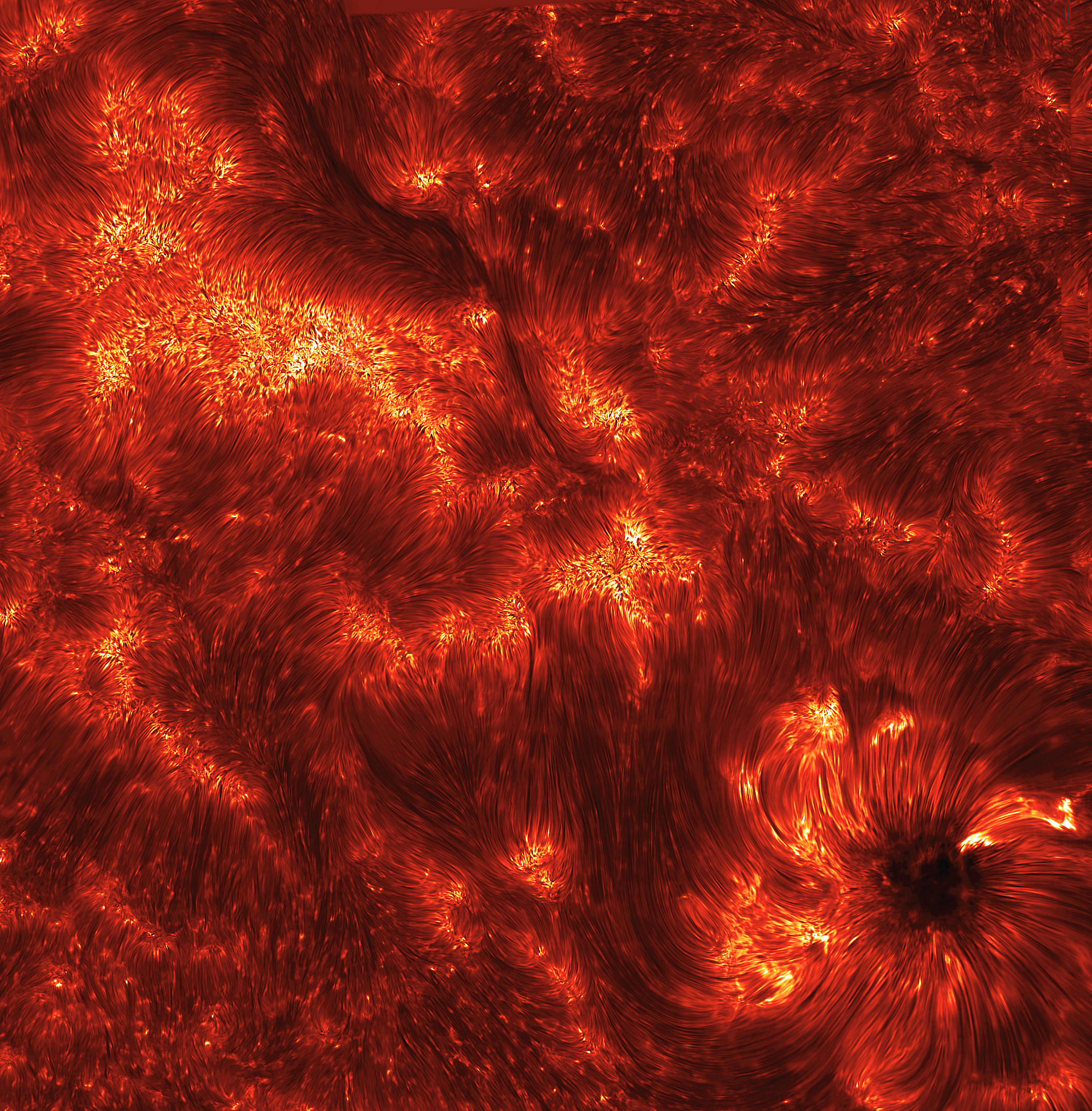
APOD 2.2


This is one of the highest resolution photographs of a spicule on the Sun.  There are thousands of these tubes of hot gas on the surface of the Sun.  Their size is comparable to the width of a state and the length of the Earth.  The surface of the Sun is always flowing and changing, due to the motion of "solar rivers" on and beneath the Sun's surface.  The tubes are shaped by magnetic fields.  They are difficult to study, due to their fast motion and short life.  Surprisingly, the cause of these spicules is thought to be sound waves trapped in the Sun.  They shoot out if they escape, but soon are quieted down and bounce around inside the Sun.  The dark area in the lower right is a sunspot, where some of the spicules seem to be converging.  The definite cause of these plasma jets is yet to be discovered.

Thursday, October 28, 2010

APOD 2.1

The name definitely suits this picture.  It is a breathtaking view of an open star cluster (Kappa Crucis), and makes you think about how minuscule we really are compared to the rest of the universe.  These stars look so dense and small, but in reality they span about 20 light years across and are found an incredible 6,400 light years away from Earth.  This is a relatively young cluster, at 10 million years old.  Its age is one reason it is dominated mostly by blue stars.  There is one red supergiant in the middle of the picture.  It is important to study open star clusters, because the stars in a cluster have very similar properties, including age, composition, and distance from Earth, however, the masses vary widely.  I was surprised to learn that the cluster was discovered in the early 1750's, because what people can do with limited technology is unimaginable.  It is one of the youngest known clusters and is located within the constellation Crux.

Sunday, October 24, 2010

APOD 1.8


The picture above is the most advanced gamma-ray map of the universe.  It was taken by the Fermi mission's Large Area Telescope (LAT) over a time frame of three months in 2008.  Gamma radiation has far more energy than visible light, and it is observed with different technology.  Although we are blind to it with the naked eye, it is found all over the universe and teaches us a lot about the places we are unable to reach.  Photos taken in wavelengths other than visible light are given false color, such as in this X-Ray picture of a globular star cluster, 47 Tuc. The labeled items are the top ten sources of gamma radiation in the universe.

Friday, October 15, 2010

Willebrord Snel Biography: Take 2

Valerie Korszen
DE Astronomy Period 1
Percival
15 October, 2010
Willebrord Snel (1580-1626)
     Born in 1580 in Leiden, Netherlands with the name Willebrord Snel van Royen, this Dutch mathematician, physicist, and astronomer later became known as Willebrord Snellius. Snellius’ father was a mathematics professor at the University of Leiden until 1613, when he himself filled this position. Snel made numerous contributions in the fields of science and mathematics, including the sine law, improvement of the method of using triangulation in measuring a distance, a proportion related to the refraction of light through a medium, and several more.
     In 1615, two years after he became professor of mathematics at the University of Leiden, Willebrord improved upon the method of determining using trigonometric triangulation, and used this method to calculate the dimensions of the Earth. Gemma Frisius was responsible for the original idea upon which Willebrord based his own. Eratosthenes Batavus was a major publication of Snel’s, which brought together his measurements and methods into a book that explains why and how these methods of triangulation were effective. He successfully measured the distance of one degree of Earth’s meridian within a few hundred meters of today’s accepted values. This is extraordinary when one considers the lack of advanced technology that he had compared to what we possess in the modern world. He had no access to satellites that could transmit data down to Earth or accurate computer systems that can measure extremely small units, indiscernible by the human body.
    One of Snel’s less significant, but still very important, contributions was his observations of the comet of 1618, and it is now named after him. He measured the parallax of the comet, which indicated that it was above the Moon’s sphere. Snel also used polygonal figures to more accurately calculate the value of pi, and in 1621, he published Cyclometria sive de circuli dimensione, which showed his work using Van Culen’s method of determining the value of pi to 34 decimal places.
     As a mathematician, Snel discovered the sine law. Using this law, he also wrote a law of refraction in 1621, which was not published until after his death. This law pertains to the angle at which a ray of light would refract through a medium and is now known as Snel’s Law. Where Johannes Kepler and Ptolemy hit a brick wall, Snel was able to explain that the sines of the angles of incidence and refraction, relative to the normal line, remain constant. This may be his most important and useful discovery, especially because it is still accepted by modern mathematicians. Christiaan Huygens put his discoveries into a book called Dioptrica in 1703. Tiphys Batavus was another posthumous work credited to Snel; it was published in 1624, only a year after his death. This book included his work pertaining to navigational theories.
     Some people who may have influenced Snel were Tycho Brahe, Johannes Kepler, and especially his father. He met the two famous scientists and studied the same subjects as them, so their discoveries would have had an impact on how he approached the problems he faced. His father was a definite influence, as he was a mathematics professor and opened up the opportunities and encouraged Willebrord to go down the path that he did.
     Snel died in Leiden on October 30, 1626. The list of contributions he made to astronomy, mathematics, and physics seems endless, which makes it very surprising that his name is not more well-known. I use the sine law almost every day in multiple classes, but never knew that Snel had not only discovered it, but had used it to make such accurate measurements of the dimensions of Earth.
Willebrord Snel Biography


Valerie Korszen
DE Astronomy Period 1
Percival
15 October, 2010
Willebrord Snel (1580-1626)
            Born in 1580 in Leiden, Netherlands with the name Willebrord Snel van Royen, this Dutch mathematician, physicist, and astronomer later became known as Willebrord Snellius.  Snellius’ father was a mathematics professor at the University of Leiden until 1613, when he himself filled this position.  Snel made numerous contributions in the fields of science and mathematics, including the sine law, improvement of the method of using triangulation in measuring a distance, a proportion related to the refraction of light through a medium, and several more. 
In 1615, two years after he became professor of mathematics at the University of Leiden, Willebrord improved upon the method of determining using trigonometric triangulation, and used this method to calculate the dimensions of the Earth.  Gemma Frisius was responsible for the original idea upon which Willebrord based his own.  Eratosthenes Batavus was a major publication of Snel’s, which brought together his measurements and methods into a book that explains why and how these methods of triangulation were effective.  He successfully measured the distance of one degree of Earth’s meridian within a few hundred meters of today’s accepted values.  This is extraordinary when one considers the lack of advanced technology that he had compared to what we possess in the modern world.  He had no access to satellites that could transmit data down to Earth or accurate computer systems that can measure extremely small units, indiscernible by the human body.
One of Snel’s less significant, but still very important, contributions was his observations of the comet of 1618, and it is now named after him.  He measured the parallax of the comet, which indicated that it was above the Moon’s sphere.  Snel also used polygonal figures to more accurately calculate the value of pi, and in 1621, he published Cyclometria sive de circuli dimensione, which showed his work using Van Culen’s method of determining the value of pi to 34 deciaml places.
As a mathematician, Snel discovered the sine law.  Using this law, he also wrote a law of refraction in 1621, which was not published until after his death.  This law pertains to the angle at which a ray of light would refract through a medium and is now known as Snel’s Law.  Where Johannes Kepler and Ptolemy hit a brick wall, Snel was able to explain that the sines of the angles of incidence and refraction, relative to the normal line, remain constant.  This may be his most important and useful discovery, especially because it is still accepted by modern mathematicians.  Christiaan Huygens put his discoveries into a book called Dioptrica in 1703.
Snel died at Leiden on the October 30, 1626.  The list of contributions he made to astronomy, mathematics, and physics seems endless, which makes it very surprising that his name is not more well-known.  I use the sine law almost every day in multiple classes, but never knew that Snel had not only discovered it, but used it to make such accurate measurements of the dimensions of Earth.

APOD 1.7


300 million light years away, these two supermassive black holes are orbiting each other.  They are at the core of two merging galaxies and are shooting out large amounts of hot gas that is millions of degrees.  They are so massive that they are pulled by each other's gravity even at 25,000 light years apart.  They are in the Abell 400 galaxy cluster and are moving at around 1200 km per second.  Since black holes do not emit visible light, the blue background is actually an x-ray image, and the pinkish gas trails are radio waves.  The swept-back look that the trails have allows astronomers to see which way the black holes are moving.  When these two collide, they will let out an incredible amount of gravitational waves.  These waves actually bend the space-time continuum and shift the distances between objects.  By the time they reach us, the event will be unnoticeable to everything other than very advanced detectors.

Thursday, October 14, 2010

Willebrord Snel Works Cited

Works Cited

Davidson, Michael W. "Willebrord Snell (1580-1626)." Molecular Expressions. Florida State University, 17 Oct. 2004. Web. 15 Oct. 2010. http://www.molecularexpressions.com/optics/timeline/people/snell.html.

Norton, Stephen D. "Willebrord Snell." BookRags.com. Thomson Corporation, 2005. Web. 14 Oct. 2010. http://www-history.mcs.st-and.ac.uk/Biographies/Snell.html.

School of Mathematics and Statistics. "Willebrord Van Royen Snell." MacTutor History of Mathematics. University of St Andrews, Scotland, Dec. 1996. Web. 15 Oct. 2010. http://www.bookrags.com/research/willebrord-snell-scit-031234/.

Struik, Dirk Jan (1970–80). "Snel, Willebrord". Dictionary of Scientific Biography. XII. New York: Charles Scribner's Sons. ISBN 0684101149.