Friday, May 6, 2011

APOD 4.3


The comet in this image was discovered by Robert McNaught.  In 2007, the spacecraft Ulysses flew through the tail of Comet McNaught (C 2009 R1), and found that the speed of the solar wind was smaller in the tail than the surrounding area.  Again, this is not one image , but many short exposure shots combined into one so that everything would appear to be moving at the same speed.  I suggest clicking on the link above and moving your cursor over the original image to see the comet without the background.  At the time this image was taken in 2010, the comet was visible in the constellation Perseus with the help of a pair of binoculars.

Friday, April 29, 2011

APOD 4.2


This is the emission nebula IC 410.  The nebula does not look like this in visible light- blue represents the presence of oxygen, hydrogen is green, and sulfer is in red.  This is a composite image taken from both narrow band and broad band filters, which separte the atoms so that astronomers can study the composition of the nebula.  The nebula is located 12,000 light years from Earth and can be found in the constellation Auriga.  The dark area in the middle is not the absence of the gases, but an area blocked by cosmic dust. The "tadpoles" (located in the upper left part of the nebula) are each 10 light years long and most likely are the location of star formation.  The nebula surrounds the galactic star cluster NGC 1893.

Thursday, April 28, 2011

Zooniverse

4/26- Galaxy Zoo Mergers: Merger Wars (1 hour)
4/28- Galaxy Zoo Hubble: Classify Galaxies (1 hour)

Tuesday, April 26, 2011

Zooniverse!

4/18- Galaxy Zoo Mergers: Merger Wars (1 hour)
4/19- Galaxy Zoo: Hubble (1 hour)

Friday, April 15, 2011

More Zooniverse

4-12: Galaxy Zoo Mergers: Merger Wars (1 hour)
4-14: Galaxy Zoo Mergers: Merger Wars (1 hour)
4-15: Galaxy Zoo: Hubble (1 hour)

Tuesday, April 12, 2011

Zooniverse Activity

3/31- Classified galaxies in Galaxy Zoo: Hubble (1 hour)
4/05- Identified supernovae in Galaxy Zoo: The Hunt for Supernovae (1 hour)
4/07- Galaxy Zoo: Hubble (1 hour)

Thursday, March 31, 2011

APOD 4.1


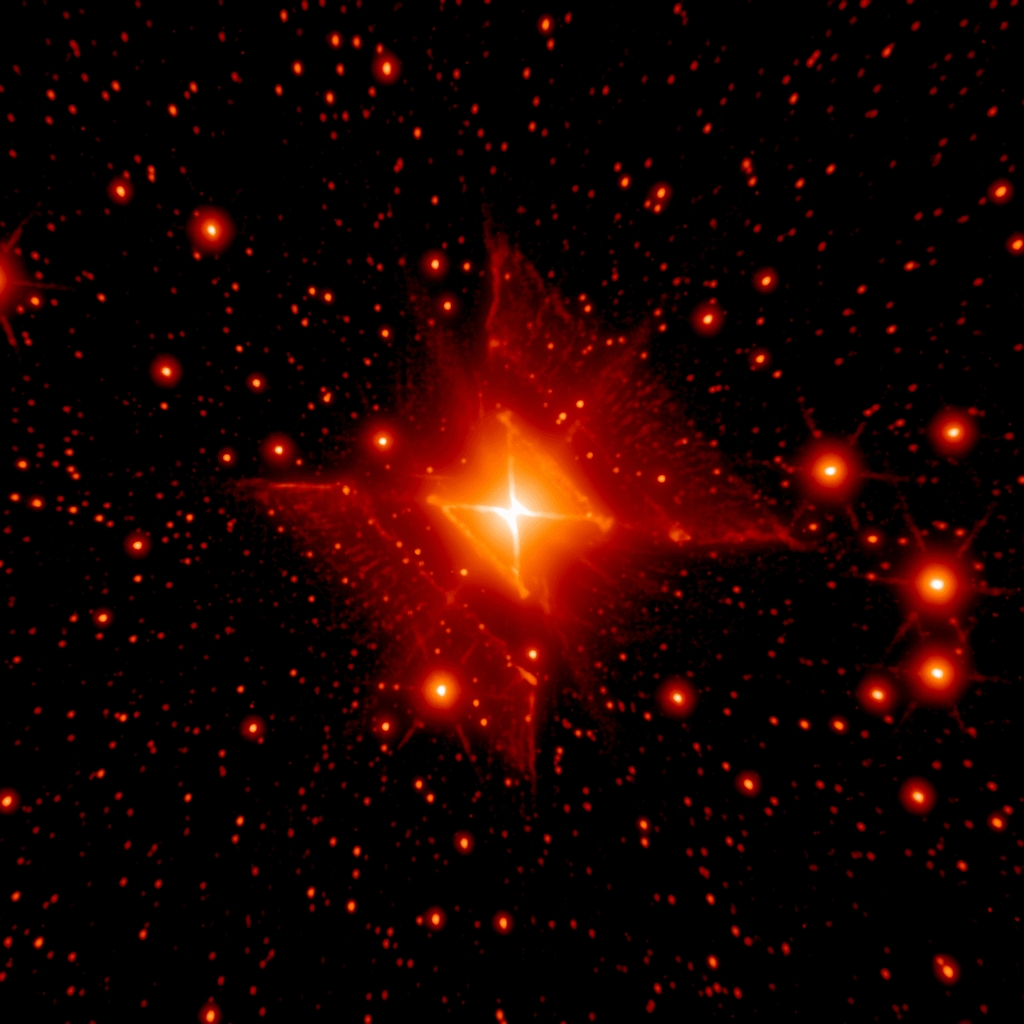
This is a strange nebula, because no one can understand why it is shaped like a square.  This picture is a combination of infrared images.  The nebula contains a hot star system, MWC 922, located in the constellation Serpens, about 5,000 light-years from Earth.  The shape suggests minimal distortion and turbulence in this area.  The three rings are similar to what was seen in supernova SN1987A, but many questions still remain.  The angle at which we view the nebula influences its shape, and it is thought to resemble the ring nebula when viewed from a different angle, but this is just one theory.